Research question: How can we separate tumor-intrinsic methylation patterns from the non-tumor signal mixed into bulk cancer samples?
The biological problem
DNA methylation profiling is a cornerstone of cancer epigenomics, but a bulk tumor measurement combines signals from tumor and non-tumor cells. That mixture can obscure the regulatory patterns that belong to the tumor itself and can confound downstream biological or clinical analyses.
The MONTE framework
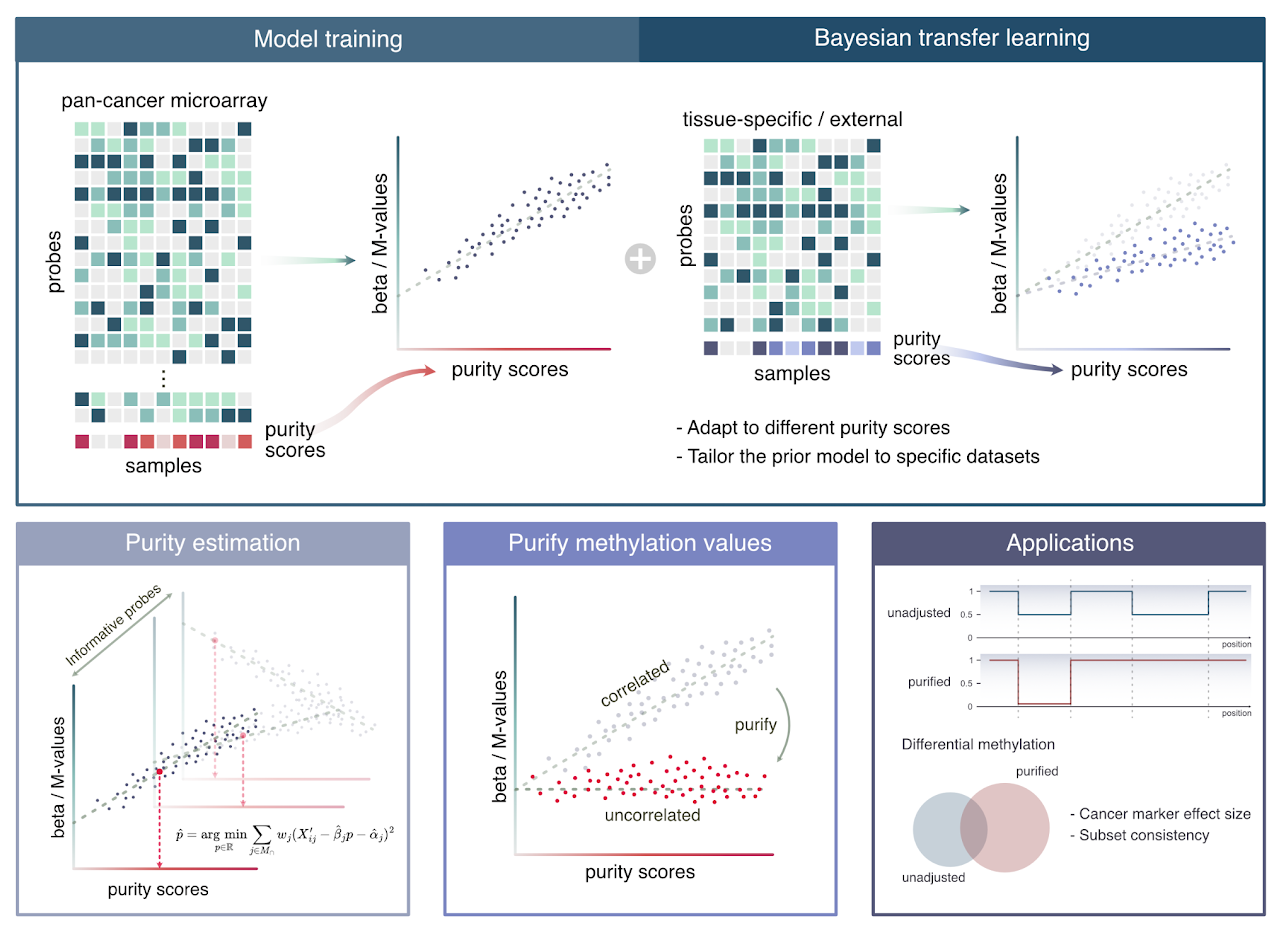
MONTE is a cancer-agnostic framework that estimates tumor purity and corrects DNA methylation signals directly from bulk data. It works at single-CpG resolution by learning probe-wise relationships between observed methylation and tumor purity.
The method does not require matched normal samples, predefined probe sets, or cancer-specific reference models. This makes the same framework applicable across cancer types while keeping the correction interpretable at the level of individual methylation probes.
Why it matters
By recovering tumor-intrinsic epigenomic profiles, MONTE provides cleaner inputs for studying cancer regulation and for downstream analyses that would otherwise inherit tumor-purity bias.
The preprint describes the model, validation, and cross-cancer evaluation. The implementation is also listed on the research software page.
Related work: ARUNA
ARUNA, developed in collaboration with Janmajay and the Yao laboratory, addresses a complementary methylation problem. It imputes missing or undetected methylation profiles from a subset of probes and can upscale lower-resolution RRBS measurements toward higher-resolution WGBS profiles.