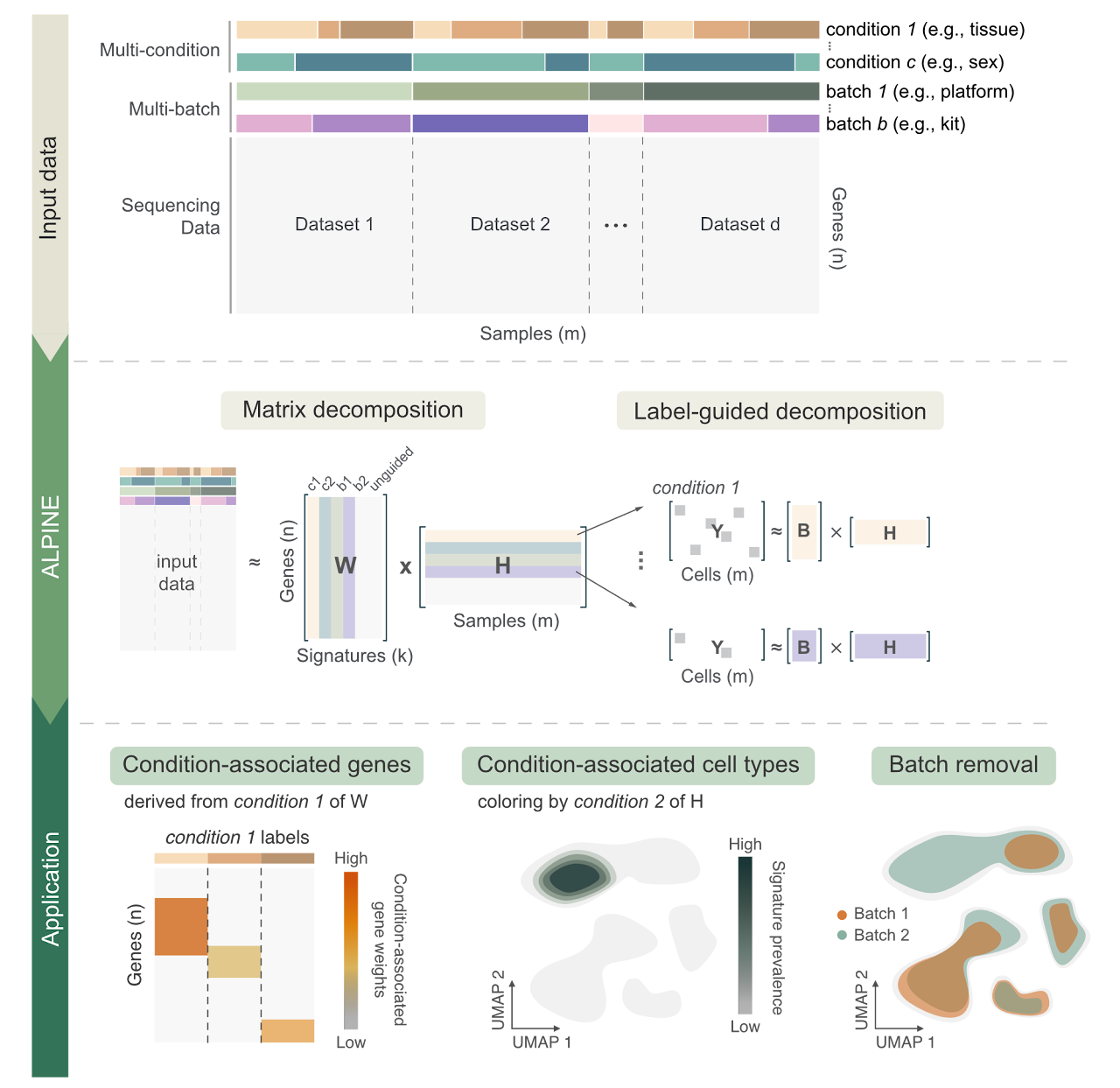
Research question: How can sequencing studies isolate a biological condition of interest without erasing meaningful variation or hiding the result inside a black-box model?
The analysis challenge
Modern sequencing studies often profile several phenotypic dimensions at once. Biological conditions, technical batches, and shared cellular programs become intertwined, making it difficult to identify which genes and patterns belong to the condition being studied.
Many integration and batch-correction methods can reduce unwanted variation, but that performance may come at the cost of interpretability. The corrected representation can be useful while offering limited insight into the genes that drive a condition-specific signal.
The ALPINE framework
ALPINE uses supervised nonnegative matrix factorization to separate condition-specific signals from shared and confounding variation. The model addresses signal separation and gene prioritization together, so its factors remain connected to the biological question.
This design supports complex experimental settings in which several sources of variation must be considered explicitly rather than collapsed into a single correction step.
What the model makes visible
ALPINE produces an interpretable decomposition of high-dimensional sequencing data and directly highlights genes associated with the target condition. That combination helps turn a corrected dataset into a biological explanation rather than treating correction as the end of the analysis.
The full evaluation appears in the Genome Research paper. The open-source implementation and installation details are also available on the research software page.